question id: PD01
Chap 25 Review
\[ \newcommand{\dnorm}{\text{dnorm}} \newcommand{\pnorm}{\text{pnorm}} \newcommand{\recip}{\text{recip}} \]
Exercise 1 What is \(\partial_x x\)?
\(0\) \(1\) \(x\) \(y\)
Exercise 2 What is \(\partial_x y\)?
\(0\) \(1\) \(x\) \(y\)
question id: PD02
Exercise 3 What is \(\partial_x a\, x\)?
\(0\) \(a\) \(x\) \(y\)
question id: PD03
Exercise 4 What is \(\partial_x x\, y\)?
\(0\) \(1\) \(x\) \(y\)
question id: PD04
Exercise 5 What is \(\partial_y x\, y\)?
\(0\) \(1\) \(x\) \(y\)
question id: PD05
Exercise 6 What is \(\partial_x A e^{kt}\)?
\(0\) \(A k e^{kx}\) \(t\)
question id: PD06
Exercise 7 What is \(\partial_t A e^{kt}\)?
\(0\) \(k A e^{kt}\) \(k A e^{kx}\) \(t A e^{kt}\)
question id: PD07
Exercise 8 What is \(\partial_x A x e^{kt}\)?
\(0\) \(A x e^{kt}\) \(A k x e^{kt}\) \(A e^{kt}\)
question id: PD08
Exercise 9 What is \(\partial_t A x e^{kt}\)?
\(0\) \(A k e^{kt}\) \(A k x e^{kt}\) \(A e^{kt}\)
question id: PD09
Exercise 10 What is \(\partial_x \left[\strut a_0 + a_1 x + a_2 x^2 \right]\)?
\(a_1 + a_2 x\) \(a_1 + 2 a_2 x\) \(a_0 + a_1 x\) 0
question id: PD10
Exercise 11 What is \(\partial_y \left[\strut a_0 + a_1 x + a_2 x^2 \right]\)?
\(a_1 + a_2 x\) \(a_1 + 2 a_2 x\) \(a_1 + 2 a_2 y\) 0
question id: PD11
Exercise 12 What is \(\partial_x \left[\strut a_0 + a_1 y + a_2 y^2 \right]\)?
\(a_1 + a_2 x\) \(a_1 + 2 a_2 x\) \(a_1 + 2 a_2 y\) 0
question id: PD12
Exercise 13 What is \(\partial_x \left[\strut a_0 + a_1 x + b_1 y + c x y \right]\)?
\(a_1 + cy\) \(a_1\) \(a_1 + b1 + c\) \(a_1 + c\)
question id: PD13
Exercise 14 What is \(\partial_y \left[\strut a_0 + a_1 x + b_1 y + c x y \right]\)?
\(b_1 + cx\) \(b_1\) \(a_1 + b1 + c\) \(b_1 + c\)
question id: PD14
Exercise 15 What is \(\partial_x \partial_y \left[\strut a_0 + a_1 x + b_1 y + c x y \right]\)? (Usually we would write \(\partial_{xy}\) instead of \(\partial_x \partial_y\), but they amount to the same thing.)
\(c\) \(a_1\) \(b_1\) \(0\)
question id: PD15
Exercise 16 What is \(\partial_x \partial_x \left[\strut a_0 + a_1 x + b_1 y + c x y \right]\)? (Usually we would write \(\partial_{xx}\) instead of \(\partial_x \partial_x\), but they amount to the same thing.)
\(c\) \(a_1\) \(b_1\) \(0\)
question id: PD16
Exercise 17 What is \(\partial_x \partial_x \left[\strut a_0 + a_1 x + b_1 y + c x y + a_2 x^2 + b_2 y^2 \right]\)? (Usually we would write \(\partial_{xx}\) instead of \(\partial_x \partial_x\), but they amount to the same thing.)
\(2 a_2\) \(a_2\) \(c + a_2\)
\(0\)
\(0\)
question id: PD17
Exercise 18 What is \(\partial_y \partial_x \left[\strut a_0 + a_1 x + b_1 y + c x y + a_2 x^2 + b_2 y^2 \right]\)? (Usually we would write \(\partial_{yx}\) instead of \(\partial_y \partial_x\), but they amount to the same thing.)
\(c\) \(2 a_2\) \(2 b_2\) \(0\)
question id: PD18
Exercise 19 What is \(\partial_x \left[\strut A x^n y^m \right]\)?
\(A n x^{n-1} y^m\) \(A n m x^{n-1} y^{m-1}\) \(A m x^{n} y^{m-1}\) \(A y^m\)
question id: PD19
Exercise 20 What is \(\partial_y \left[\strut A x^n y^m \right]\)?
\(A n x^{n-1} y^m\) \(A n m x^{n-1} y^{m-1}\) \(A m x^{n} y^{m-1}\) \(A m y^{m-1}\)
question id: PD20
Exercise 21 What is \(\partial_{xy} \left[\strut A x^n y^m \right]\)?
\(A n x^{n-1} y^{m-1}\) \(A n m x^{n-1} y^{m-1}\)
\(A m x^{n} y^{m-1}\) \(A m x^{n-1} y^{m-1}\)
\(A m x^{n} y^{m-1}\) \(A m x^{n-1} y^{m-1}\)
question id: PD21
Exercise 22 What is \(\partial_x \left[\strut f(x) + y\right]\)?
\(\partial_x f(x)\) \(\partial_x f(x) + 1\) \(\partial_x f(x) + y\) \(0\)
question id: PD22
Exercise 23 What is \(\partial_x \left[\strut f(x) + g(y)\right]\)?
\(\partial_x f(x)\) \(\partial_x f(x) + \partial_x g(y)\) \(\partial_x f(x) + \partial_y g(y)\) \(0\)
question id: PD23
Exercise 24 What is \(\partial_y \left[\strut f(x) + g(y)\right]\)?
\(\partial_x f(x)\) \(\partial_x g(y)\) \(\partial_y g(y)\) 0
question id: PD24
Exercise 25 What is \(\partial_x \partial_y \left[\strut f(x) + g(y)\right]\)?
\(\partial_x f(x)\) \(\partial_x \partial_y g(y)\) \(\partial_y g(y)\) 0
question id: PD25
Exercise 26 What is \(\partial_y \partial_y \left[\strut f(x) + g(y)\right]\)?
\(\partial_y g(y)\) 1 \(\partial_{yy} g(y)\) 0
question id: PD26
Exercise 27 What is \(\partial_y f(x) g(y)\)?
\(\partial_y g(y)\) \(f(x)\ \partial_{y} g(y)\) 0 \(g(y)\ \partial_y f(x) + f(x) \ \partial_y g(y)\)
question id: PD27
Exercise 28 What is \(\partial_y h(x,y) g(y)\)?
\(\partial_y g(y)\) \(g(y) \partial_y h(x, y)\) 0 $ g(y) _y h(x,y) + h(x,y) _y g(y)$
question id: PD28
Exercise 29 What is \(\partial_x h(x,y) g(y)\)?
\(\partial_x h(x, y)\) \(g(y)\ \partial_x h(x,y) + h(x,y)\ \partial_x g(y)\) \(g(y) \partial_x h(x, y)\) \(g(y) \partial_y h(x, y)\)
question id: PD29
Exercise 30 What is \(\partial_{yx} h(x,y) g(y)\)?
\(\partial_{yx} h(x, y)\)
\(g(y) \partial_{yx} h(x,y) + h(x,y)\ \partial_y g(y)\)
\((\partial_y g(y)) \ (\partial_x h(x, y)) + g(y)\ (\partial_{yx} h(x, y))\)
\((\partial_x g(y))\ (\partial_x h(x, y)) + g(y) (\partial_{xx} h(x, y) )\)
question id: PD30
Exercise 31 What is the “with-respect-to” input in \(\partial_y xy\)?
\(x\) \(y\) \(1\)
question id: PD31
Exercise 32 What is the “with-respect-to” input in \(\partial_x y\)?
\(x\) \(y\) \(1\)
question id: PD32
Exercise 33 What is the “with-respect-to” input in \(\partial_t y\)?
\(t\) \(y\) \(1\)
question id: PD33
Exercise 34 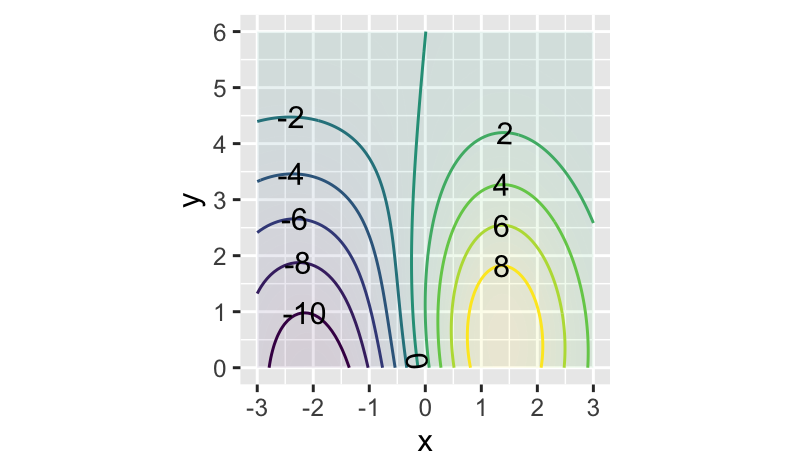
You have been hiking all day and have reached map coordinate (x=2, y=2). You are completely exhausted. Time for a break. You want to walk along the hill, without any change of elevation. Which compass direction should you head in to get started?
W or SE
SE but not NW
NW but not SE
NE or SW
question id: r2-21
No answers yet collected