WarningRemember to hand in your work …
At any point, you can submit your answers by collecting them and uploading them to the class site.
No answers yet collected
If requested by your instructor, please identify here the people from whom you received assistance on this assignment.
If the answers that have been loaded automatically are not yours, press this button before starting your work:
Chap 3. Exercises
Exercise 3. 1 The following is from the Atlantic magazine article, “Science Is Winning the Tour de France” (by Matt Seaton, July 25, 2025)
The gold standard of cycling performance—which boils down to a rider’s ability to push against the wind and go uphill fast—is a high power-to-weight ratio, given in watts per kilogram. The benchmark figure is how many watts per kilo a cyclist can sustain for a one-hour effort. Every rider now has a power meter fitted to their bike, so they know their numbers in a constant, real-time way (together with heart rate, speed, and other measurements).
The article describes the then-current leader in the Tour de France as having a power-to-weight ratio of seven watts per kilogram.
- If this rider weighs 70 kg, how many watts can he generate?
sbk-1-vsw
- Look up the conversion factor from watts to horsepower. How many horsepower is the rider generating?
sbk-2-ie2d
- A horse weighing 500 kg can generate one horsepower while walking. How does the horse’s power efficiency per weight compare to the champion bike rider.
sbk-3-r7f
- There is no conversion factor from watts to calories. Why not?
sbk-4-ri3
- Look up the conversion factor from watt-seconds to kilo-calories (kcal (or “Cal”), the relevant unit when looking at diet). How many kcal does the rider produce when biking for one hour at 7 w/kg?
sbk-5-nsl2
- It’s estimated that a person’s efficiency when converting dietary calories to work/movement calories is about 25%. In an hour of biking at 7 w/kg, how many dietary calories does a 70-kg rider consume?
sbk-6-fjfk
- An “average” adult walking at 2.5 mi/hr is said to use about 150 watts of power. For this hypothetical adult, how much energy is consumed in a 1-hour walk?
sbk-7-fjfk
- In the exercise/diet literature it’s said that walking a mile consumes about 100 kcal.
This is (roughly) consistent with the 150 watts of power claimed when waking at 2.5 mi/hr.
WarningNext status step: Refine the draft
… to make it ready for testing.
Assigned to DTK
Exercise 3. 2
The three temperature scales—C, F, and K—define zero degrees differently. This make it hard to do the conversion in one’s head.
The computational chunk that follows provides two functions, FtoC() and FtoK()
- What is the change in C when F increases by 10 degrees?
dfs-1-is4
- What is the rate of change of C with respect to F?
dfs-2-krod
- What is the dimension of the rate of change of C with respect to F?
dfs-3-owe
- What is the rate of change of F with respect to C?
dfs-4-krod
- Extra credit: What is the rate of change of C with respect to K? (Hint: You’ll need to give two temperatures in F, converting them to both C and K.)
dfs-5-s8w
Exercise 3. 3 Write a problem about “mortality” versus “mortality rate.”
- The mortality rate is 100% for people. What is the “with respect to” variable that makes sense of this claim?
rsf-1-eks
- Mortality in the Civil War Battle of Chickamauga was about 25%. This is much lower than the mortality of 100% experienced by the population at large. Explain.
- According to the US Census Bureau, the mortality rate for middle-aged men and women is about 0.5. What must be the units and with respect to variable for this to make sense?
Exercise 3. 4 Perspectives on percent …
- The first thing to keep in mind is that percent is a unit of [1], written by moving the decimal point two places to the right.
- 0.0542 is 5.42%.
- 2.612 is 261.2%.
- 0.0005 is 0.05%.
You can write any number in units of percent. The advantage to doing so is that it converts numbers in the range 0.01 to 1 into the range 1 to 100. People can process such two-digit numbers like 56% faster and perhaps more reliably than numbers like 0.56.
- As a matter of practice, “percent” is also used to designating a proportion of some whole.
- If the whole is 100 miles … 12% corresponds to 12 miles.
- If the whole is 0.08 liters … 25% corresponds to 0.02 liters.
- If the whole is 4,000,000 USD … 50% corresponds to 2,000,000 USD
- If the whole is 3 kg … 400% corresponds to 12 kg.
In this context, the symbol “%” serves two purposes: to indicate that the decimal point has been moved two digits to the right; and, to replace the words “a fraction of,” or “a proportion of,” or “of the whole.”
- Example: “a fraction of 0.11 of 700 seconds is 77 seconds” can be replaced with “11% of 700 seconds.” Much shorter.
Percent is also sometimes used as a trick to fooling the reader into thinking a quantity is larger than it really is. For instance, 5 and 500% are the same quantity, but 500% has more digits and may look more imposing. Should this propaganda use be distained?
Percent is often used to signify a proportional amount of growth or decline. For example, a five-fold increase from 2 to 10 can be expressed as a growth of 400%. Why 400% and not 500%? That’s because the original value, 2 here, corresponds to 100% of itself. The end value, 10 in this example, is 500% of 2, so the amount of change is 500% - 100% = 400%. Another way to see this: the change from 2 to 10 involves an increase by 8. Since 8 is four times 2, we can say the increase by 8 is an increase by 400% of the starting value 2.
Likewise, an increase by 5% is the same as an increase to 105% of the original value.
Decreases are even more confusing. A decrease of 20% corresponds to a change to 80% of the original value.
Percentages, when used to signify “a proportion of,” do not add. For instance, starting at 100 USD, two successive increases of 20% (that is 20% then another 20% increase) leads to an overall increase of 44%.
“Percent” and “percentage points” are not the same thing. Use “percentage point” only when referring to a change in a proportion. For instance, if inflation is at 5% and then changes to 7%, we have an increase by 40% in inflation or, stated differently, an increase by 2 percentage points.
When you encounter percent or “percentage points,” make sure you understand whether they are talking about a the “proportion of something,” a “percentage increase,” a “percentage point increase.” If it is a change—increase or decrease—you should be aware of what the starting level of the quantity was.
To illustrate how one might be mislead by percent and percentage points, consider this statement from an AI:
Cigarette smokers face significantly higher mortality risks than non-smokers, with studies showing smokers are about twice as likely to die prematurely, experiencing higher rates of lung cancer, heart disease, and respiratory illnesses; for example, one study found current smokers had an overall mortality rate of around 11 per 1,000 person-years, compared to about 3 per 1,000 for never smokers, with risks increasing with the amount and duration of smoking.
Cigarette smokers have a 100% greater risk of premature death. dsl-1-72kd
Would (1), if true, mean that smokers are certain to die prematurely? dsl-2-72kd
The mortality rate of cigarette smokers is 267% greater than for non-smokers. dsl-3-gsd
Does (3), if true, mean that cigarette smokers have a mortality rate greater than 100%? (Cats, with their proverbial nine lives, might get away with this, but not people.) dsl-4-hwdw
The mortality rate of smokers is 0.8 percentage points higher than for non-smokers.
- Does (5), if true, mean that smoking is not a big deal? Explain why or why not.
Exercise 3. 5 Thanksgiving chefs can easily find recommendations for roasting turkey. On source suggests 13-15 min/lb at a temperature of 325-350°F. Another source recommends 15-20 min/lb at a temperature of 325°F.
- Explain why it’s sensible to convey the cooking time using a rate, rather than just saying how long to cook the bird.
- Of course, there are other rates that can be constructed: cooking time with respect to …. For instance, cooking time depends on temperature. Would it make sense to have a rate like 0.5 min / °F? Explain how this might help or whether it makes any sense at all.
Back to cooking time versus weight …
Once source gives a handy table for cooking at 325°F:
- 10 pounds: cook 165 min
- 15 pounds: cook 210 min
- 18 pounds: cook 240 min
- 21 pounds: cook 270 min
- Between 10 and 15 pound turkeys, what is the rate of change in cooking time with respect to weight?
fip-3-w4s
- Between 10 and 15 pound turkeys, what is the rate of change in cooking time with respect to weight?
fip-4-flw
Exercise 3. 6 AI Generated Exercise: The Freelance Consultant’s Dilemma
Scenario: Lydia is a freelance graphic designer who is trying to determine her “Productivity Rate” to better quote future clients. Last week, she spent 15 hours designing a 60-page annual report for a local non-profit. This week, she spent 12 hours creating a 40-page brand style guide for a startup.
The Question: Which of the following statements correctly compares Lydia’s rates of production between the two projects?
als-1-krfis
Note from human: This is the kind of problem familiar from textbooks where knowing what chapter the question refers to tells the student the kind of answer that is expected. This chapter is about “rates,” so rates must be part of the answer! A more authentic question might leave it to the student to decide whether a rate provides a good approach. For instance, if the length of the report were irrelevant, the overall time spent might be the correct measure of productivity (or, rather, “unproductivity.”). Page count is easy to measure, but not clearly related to the purpose at hand. Often, a high page count is a mechanism to hide information.
President Woodrow Wilson (1856-1924) is reported to have said, “If I am to speak ten minutes, I need a week for preparation; if fifteen minutes, three days; if half an hour, two days; if an hour, I am ready now.”
Exercise 3. 7 AI-generated question:
At a local cafe, you are deciding between two bags of coffee beans. Brand A costs $14.40 for a 12-ounce bag. Brand B costs $18.00 for a 16-ounce bag. Which brand offers the better value based on the unit price per ounce?
sft-1-qifl
Human comments:
A “unit price” of a product is the price per unit amount of the product. For coffee, the sensible unit for amount is ounces. For other substances, the unit might be stated in terms of mass or count, etc. “Unit price per ounce” sounds like a compound ratio: the unit priced divided by the number of ounces. This would double-count ounces. “Price per ounce” on its own says what they are looking for to measure value.
The last item in the multiple choice should not be ruled out. If you are only going to use 8 ounces before the coffee becomes stale, buy the cheaper bag. The problem statement nullifies this choice, since it says, “based on the unit price” with the unit defined as ounces, not bags. Responsible modelers check such assumptions to make sure they are aligned with the actual purpose of the model. A rule of thumb for consultants is to check first whether what the client says they want is really what they want.
Exercise 3. 8 AI generated.
You are planning a trip to London and need to exchange some money. The current exchange rate is 1 British Pound (£) to 1.25 U.S. Dollars ($). If you have $600 for spending money, how many British Pounds will you receive (assuming no fees)?
dbf-1-pcas
Human comments:
The proper choice between the first two answer candidates is difficult, because it’s rendered as the distinction between dividing and multiplying. Such problems would be easier if conversion was always presented a multiplying by the conversion factor. Of course, you have to construct the correct conversion factor.
“The rate of 1.25” is not stated with the proper units. The units are dollars/pound, with the “flavor of one” is based on the equality of 1 pound to 1.25 dollars. However, since the conversion is from dollars to pounds, the flavor of one should have pounds on the top and dollars on the bottom: one pound per 1.25 dollars, or, equivalently 0.8 pounds per dollar. The to units need to go on the top of the conversion factor with the from units on the bottom: 1 pound per 1.25 dollars.
Almost everyone has trouble with the term “stronger” when used with currency. It would be sensible to quantify “strength” by the amount of stuff you can buy with a unit of currency. So which is stronger: 1.25 dollars or 1 pound? They are the same strength since those amounts are equivalent to one another. Better to frame the question in terms of 1 unit for each currency. Which is stronger: 1 dollar or 1 pound? 1 pound will buy more than 1 dollar, so the pound is “stronger.”
The metaphor of strength/weakness makes better sense when you look at changes in the exchange rate. But care is still needed. Suppose you want to say whether the dollar or the pound is getting stronger. For dollars, you need to look at the exchange rate in terms of pounds per dollar. If that exchange rate is going up, the dollar is getting stronger. If down, the dollar is getting weaker. For instance, suppose yesterday’s exchange rate of 1 pound per 1.25 dollar changes to 1 pound per 1.30 dollars. 1/1.25 is larger than 1/1.30, so the dollar is getting weaker. You need more dollars ($1.30) to buy the same stuff you could buy yesterday for $1.25.
Exercise 3. 9 AI generated: The Urban Garden Project
Scenario: You are volunteering for a community garden. You need to apply liquid fertilizer to 480 individual tomato seedlings. The manufacturer’s instructions state that you must use a rate of 3 fluid ounces of fertilizer per 8 seedlings.
The Question: The fertilizer is only sold in 1-quart bottles. How many bottles do you need to buy to treat all the seedlings? (Note the conversion factor: 32 fluid ounces = 1 quart)
clf-10-mfdmd
Human comment:
This problem involves two different transformations:
- Transform 480 seedlings into ounces of fertilizer.
- Convert from fluid ounces of fertilizer to quarts of fertilizer.
Note the use of two different verbs: “transform” versus “convert.” Fluid ounces of fertilizer and quarts of fertilizer are merely different units for the same kind of thing. We use conversion factors to convert one such unit into the other. As always, the from unit goes on the bottom and the to unit on the top. Since 32 fluid ounces equals one quart, the “flavor of one” conversion factor will be \(\frac{1\, \text{quart}}{32\, \text{fluid ounces}}\) which is dimensionless, like all conversion factors.
On the other hand, seedlings are not the same kind of thing as fertilizer. There is no universal “flavor of one” to convert one into the other. But there is a rate for fertilizer use per seedling. It’s given as 3 oz per 8 seedlings or 3/8 oz per seedling. This is not a dimensionless rate. Multiplying this rate by 480 seedlings gives \[480\, \text{seedings} \times \frac{3\, \text{fluid ounces}}{8\, \text{seedlings}} = 60 \times 3\, \text{fluid ounces} = 180\, \text{fluid ounces}\]
Now convert 180 fluid ounces to quarts:
\[ 180\, \text{fluid ounces} \times \frac{1\, \text{quart}}{32\, \text{fluid ounces}} = \frac{180}{32} \times 1\, \text{quart} = 5.625\, \text{quarts}\]
Exercise 3. 10 AI generated question: In quantitative reasoning, acceleration is one of the most interesting rates because it is a compound rate. Speed is the rate of change of distance with respect to time, while acceleration is the rate of change of speed with respect to time.
To master this, we look at how the units of time appear twice in the denominator, often expressed as “meters per second squared.”
Question: Deceleration at the Intersection
Scenario: You are driving a car at a constant velocity of 24 meters per second (24 m/s). You see a traffic light turn red ahead of you. You apply the brakes and come to a complete stop (0 m/s) in exactly 4 seconds.
The Question: Which of the following correctly describes your rate of acceleration (deceleration) and the meaning of its units?
ats-1-swed
Exercise 3. 11 AI generated in response to a prompt about “fuel economy” versus “fuel consumption.”
This is a fantastic topic for our quantitative reasoning course because it highlights how different cultures choose different units to represent the same concept—and how those choices change the math.
In the United States, we use Fuel Efficiency (Distance/Volume), while in Europe and much of the world, they use Fuel Consumption (Volume/Distance).
Scenario: You are comparing two rental cars for a road trip.
The American Model: Rated at 30 miles per gallon (mpg).
The European Model: Rated at 8 liters per 100 kilometers (L/100km).
To compare them, you need to convert the European rating into “American” units. Use the following conversion factors:
- 1 gallon ≈ 3.8 liters
- 100 kilometers ≈ 62 miles
Question: What is the approximate fuel efficiency of the European model in miles per gallon, and which car is more “efficient” (uses less fuel per mile)?
bbg-1-cfr
Exercise 3. 12 Modeling of intravenous (IV) fluid administration.
As you likely know, an IV is a mechanism for adding fluid to a patient’s bloodstream at a desired flow rate. The real-world system is somewhat complicated, involving bags of fluid, tubing, clamps, and an ingenous device called a drip chamber. A nurse setting up an IV has to keep track of many things, including how to exclude air bubbles from entering the patient’s bloodstream, how to maintain aseptic standards, and such. If you are interested, this video is part of training materials for nurses, and shows how an IV is set up. There are many, many steps and several different techniques.
We are going to build a model of an IV system. Like all models, our model will have a purpose. In our case, the purpose is to calculate how to regulate the fluid flow at the proper rate.
A physician’s order to a nurse might be to infuse one liter of fluid over an eight-hour period. (Why eight hours? Likely because that’s when the next nursing shift will come in.) This quantity (1 L per 8 hours) is a flow rate stated as a rate of change: a change of 8 hours in time will lead to an additional one liter of fluid being administered. Regulating the flow means to set up the system to deliver the specified flow rate.
Physically, the system consists of a bag of fluid, to which is connecting a tubing set. The top of the tubing is a plastic spike that is inserted into a port of the bag. attached to the bag, the bottom end is a needle to be inserted into a vein. In between, there are two devices, a drip chamber and an adjustable clamp. Fig E3. 1 shows a typical setup for the tubing; the bag and the patient are not shown.


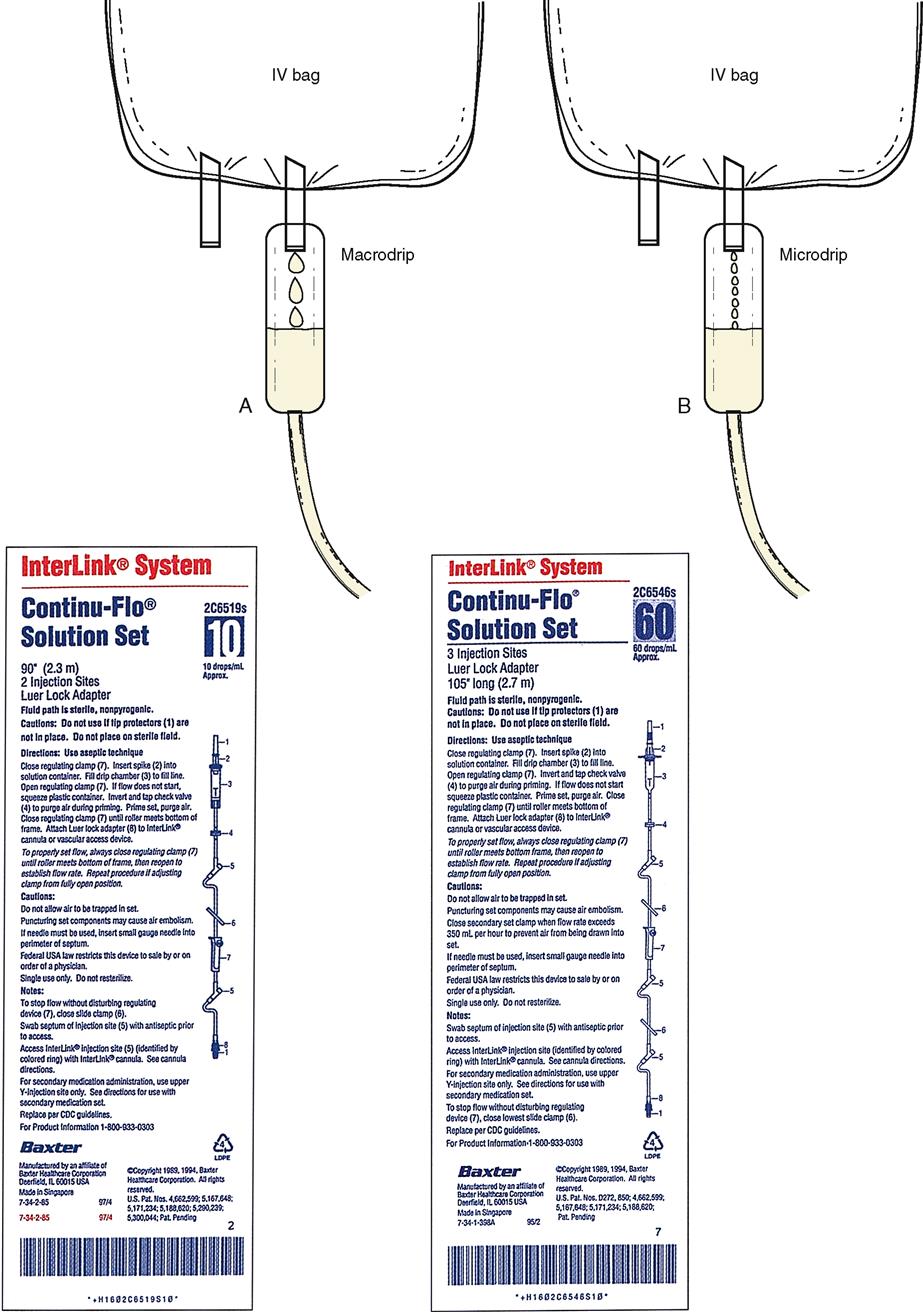
The clamp is used to restrict flow through the tube. The resistance is set by a roller that can be moved by the nurse. The drip chamber is used to measure the flow rate through the tube. The chamber is more or less a transparent vial that, in use, is half-filled with air at the top and liquid at the bottom. There is a small nipple at the top; the fluid flows through in drops.
The package label shows conspicuously the number 10 in a blue box. That corresponds to a rate: 10 drops per mL. (The abbreviation for “drops” is gtts, so the rate is 10 gtts mL-1.) Different tubing sets can have different drop rates. For instance, pediatric tubing comes at 60 gtts mL-1.
The goal of the nurse is to set (using the clamp) the number of drops per minute to correspond to the prescribed flow rate.
Let’s see if we have enough information for the nurse to determine what is the right rate of drops per minute (that is, gtts min-1) that corresponds to the correct flow. Here are three quantities, of which the third is as yet unknown:
\[\overbrace{\underbrace{\frac{1}{8}\frac{\text{L}}{\text{hr}}}_\text{prescribed flow}}^\text{Rate A}\ \ \ \ \ \ \overbrace{\underbrace{10 \frac{\text{gtts}}{\text{mL}}}_\text{volume of a drop}}^\text{Rate B}\ \ \ \ \ \overbrace{\text{???} \frac{\text{gtts}}{\text{min}}}^\text{Target}\],
Our goal is to find out how to combine Rate A and Rate B by multiplication or division in order to get to the target. For instance, the answer might be A/B, or A \(\times\) B or B / A or 1/(A \(\times\) B).
The way to start is by writing down the dimension of Rates A and B. Keep in mind that the unit L refers to liters. The dimension L however, refers to length. [L] = [volume] = L3.
- What is the dimension of Rate A?
ehk-1-3sk
- What is the dimension of gtts, that is, [gtts]?
ehk-2-si3
- What is the dimension of Rate B, that is, [gtts/mL]?
ehk-3-esle
- What is the dimension of the target, that is, [gtts/min]?
ehk-4-lfdw
We can multiply and divide dimensions in whatever way we like. For instance, (L T-2)-1 if T2 L-1.
- What’s the way to combine [Rate A] and [Rate B] to end up with [target]?
ehk-5-eks
This dimensional analysis tells us how to combine the quantities Rate A and Rate B. Carry out the combination according to your answer to Question 5.
- What is the quantity of the combination:
ehk-6-kr3e
Your answer to (6) is the target quantity, but it has some funny units:
1.25 L hr^{-1} gtts mL-1, or, re-arranging, `1.25 (L/mL) (gtts/hr)
We don’t want hours, we want minutes. One hour is 60 minutes. So re-arrange again:
1.25 {L/mL) (gtts/60min) To convert hours to minutes, multiply by 60 min hr-1. And isn’t L/mL a dimensionless quantity? Since one L is 1000 mL, L/ mL = 1000. So we get
1.25 gtts / (60 min) = 1250/60 = 20.8 gtts/min.
The nurse should adjust the roller on the clamp so that there are about 20 drops per minute, or 1 drop every 3 seconds.
File ID: avoid-send-painting
Exercise 3. 13 Conversion factors. Show that the different directions of conversion are reciprocals.
File ID: kitten-light-pantry
Exercise 3. 14 It’s also convenient if the same units are used for both since that lets you do the calculation using ordinary subtraction. Otherwise, you first have to convert one of the quantities to have the same unit as the other.
File ID: lobster-tear-clock
Exercise 3. 15 The rate of energy while running captured the “amount of running” in units of mile-pounds. But doesn’t speed enter into it? It’s common sense that running faster involves a larger “amount of running.” If this were the case, the units for the amount of running would be mile-pounds-mile/hour or miles2-pound/hour. That’s a strange-looking unit. It turns out, however, that running speed is not an important factor in determining the amount of energy used to run a mile-pound. Instead, the increased effort for running fast is due to higher power use, where power is energy per time.
File ID: duck-see-magnet
Exercise 3. 16 Economist’s Big Mac index to introduce the adjustment
List of per capita PPP by country
See price levels (relative to US) in this Wikipedia article.
Question for students … Would it make a difference if some other country were used as the baseline for price levels?
https://www.imf.org/en/Publications/fandd/issues/Series/Back-to-Basics/Purchasing-Power-Parity-PPP
File ID: girl-choose-piano
Exercise 3. 17 Velocity as a rate of change of position w.r.t. time. Acceleration as a rate of change of velocity w.r.t. time. Velocity has dimension L/T. Acceleration has dimension (L/T)/T or L T-2
File ID: reptile-speak-piano
–>