Quantitative Argumentation
Chapter 9 Reading Questions
Exercise 1 What is the role of coefficients in building a linear combination?
Exercise 2 Imagine you have three functions \(f()\), \(g()\), and \(h()\) each of which takes a single argument. (They might, for instance, be input-scaled core modeling functions.) Here are some different ways of composing a new function out of them:
- \(one( ) \equiv f(x) g(y) + h(z)\)
- \(two( ) \equiv g(h(y)) + f(y)\)
- \(three( ) \equiv g(y) (h(x) + f(y))\)
- \(four(z, y) \equiv f(g(z)) h(y)\)
We have given names to the newly constructed functions: \(one()\), \(two()\), \(three()\) and \(four\). But the definitions are incomplete for the first three functions since there are no argument names given in the parentheses on the left side of \(\equiv\). On the other hand, \(four()\) is defined with argument names.
For each of \(one()\), \(two()\), and \(three()\), say what the argument names should be to have a sensible function definition.
Exercise 3 For each of the four functions in (2), list each of the methods—linear combination, function multiplication, and pipelining—that have been used when defining the function.
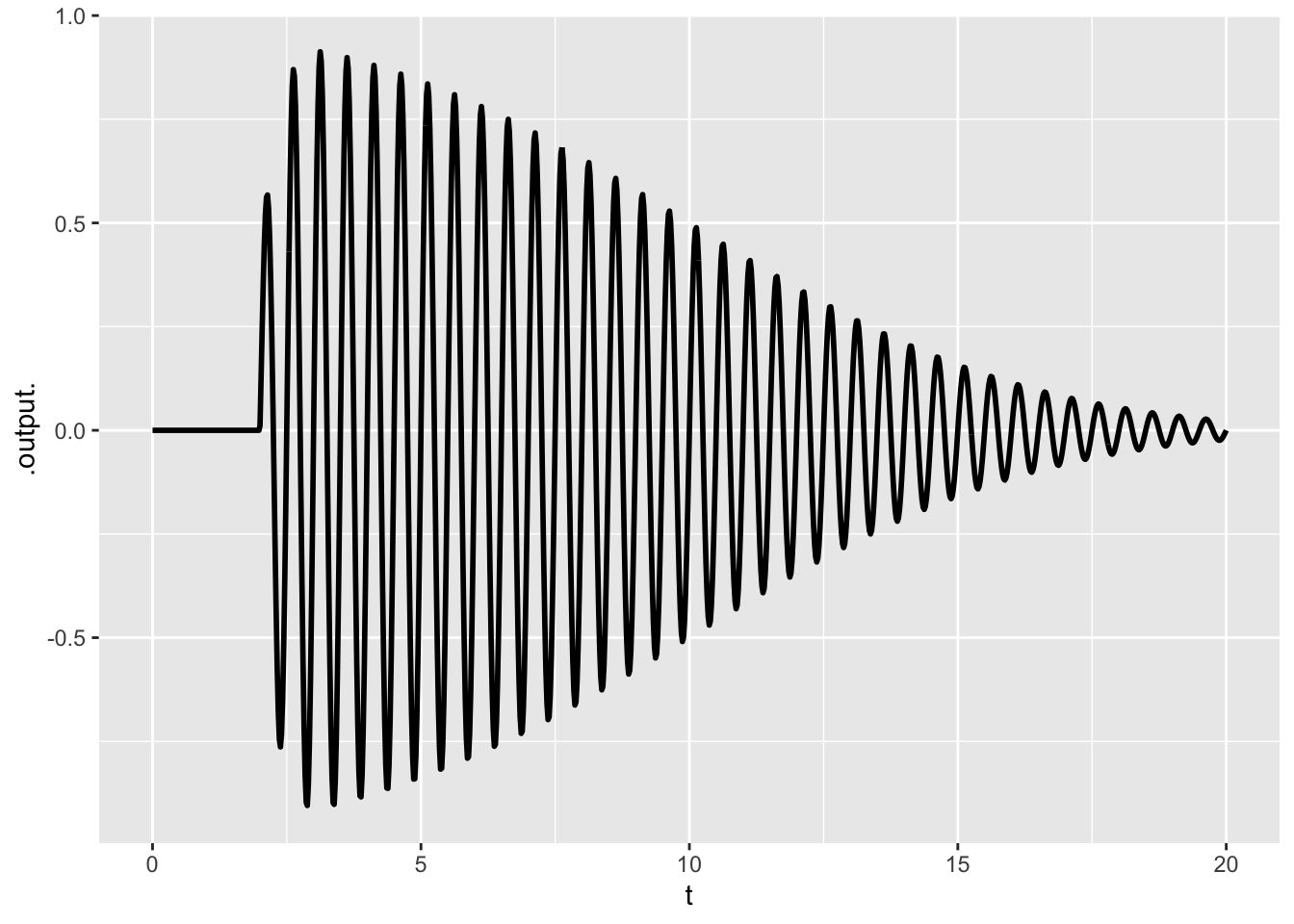
Exercise 4 The sound wave following tapping a tuning fork looks something like this (although the oscillation is much faster than shown):
The tuning-fork function shown is different from any of the core modeling functions. Pick the core modeling function that is most similar and explain how the tuning-fork function differs from it.