Placeholder for now
krs-topmost
Quantitative Argumentation
Chapter 11 Exercises
Note11.A
Exercise 1 The figure shows six different instantaneous configurations for a pendulum as it swings. The curved arrow shows the velocity of the bob. The length of the curved arrow is the velocity times one second.
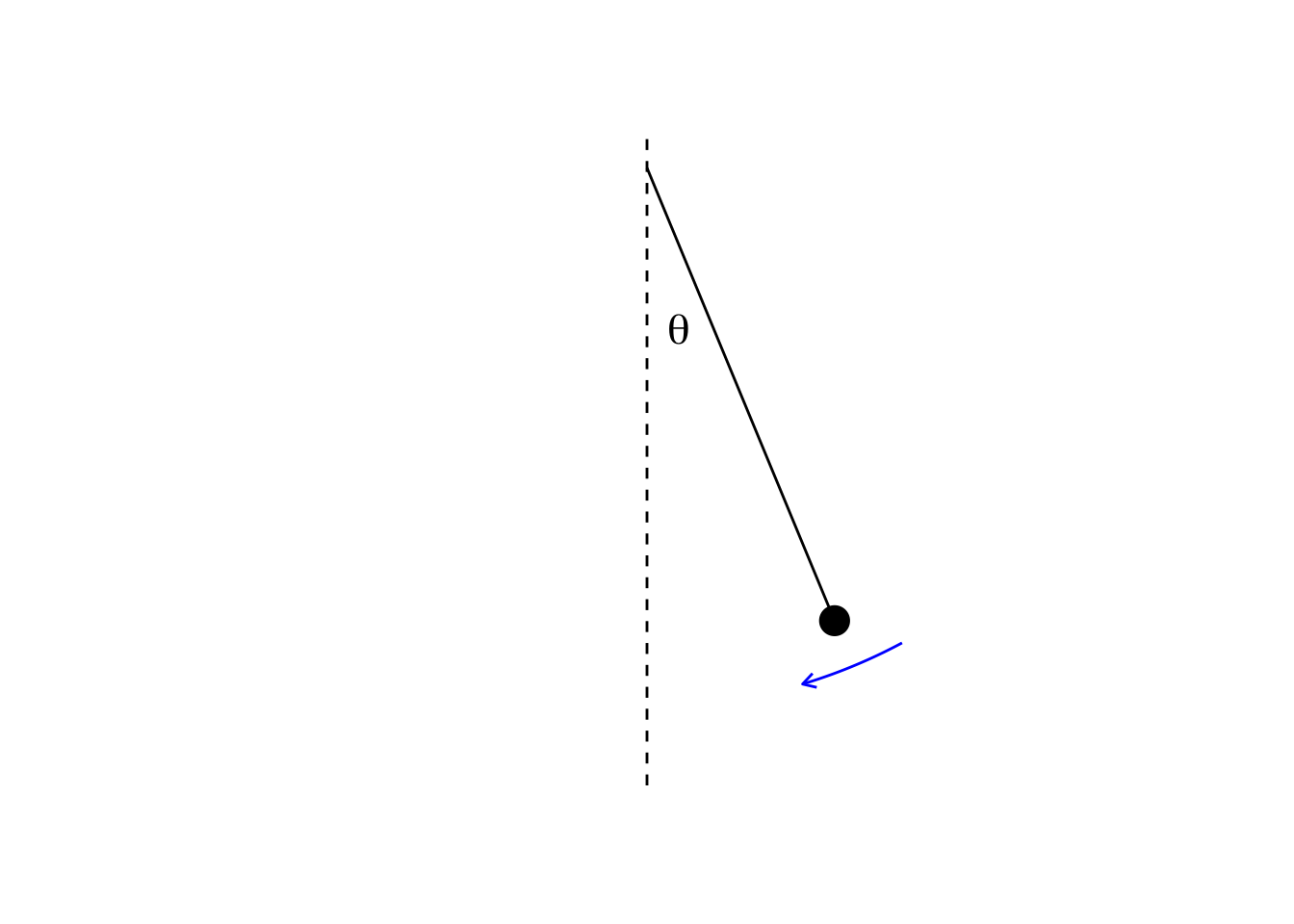
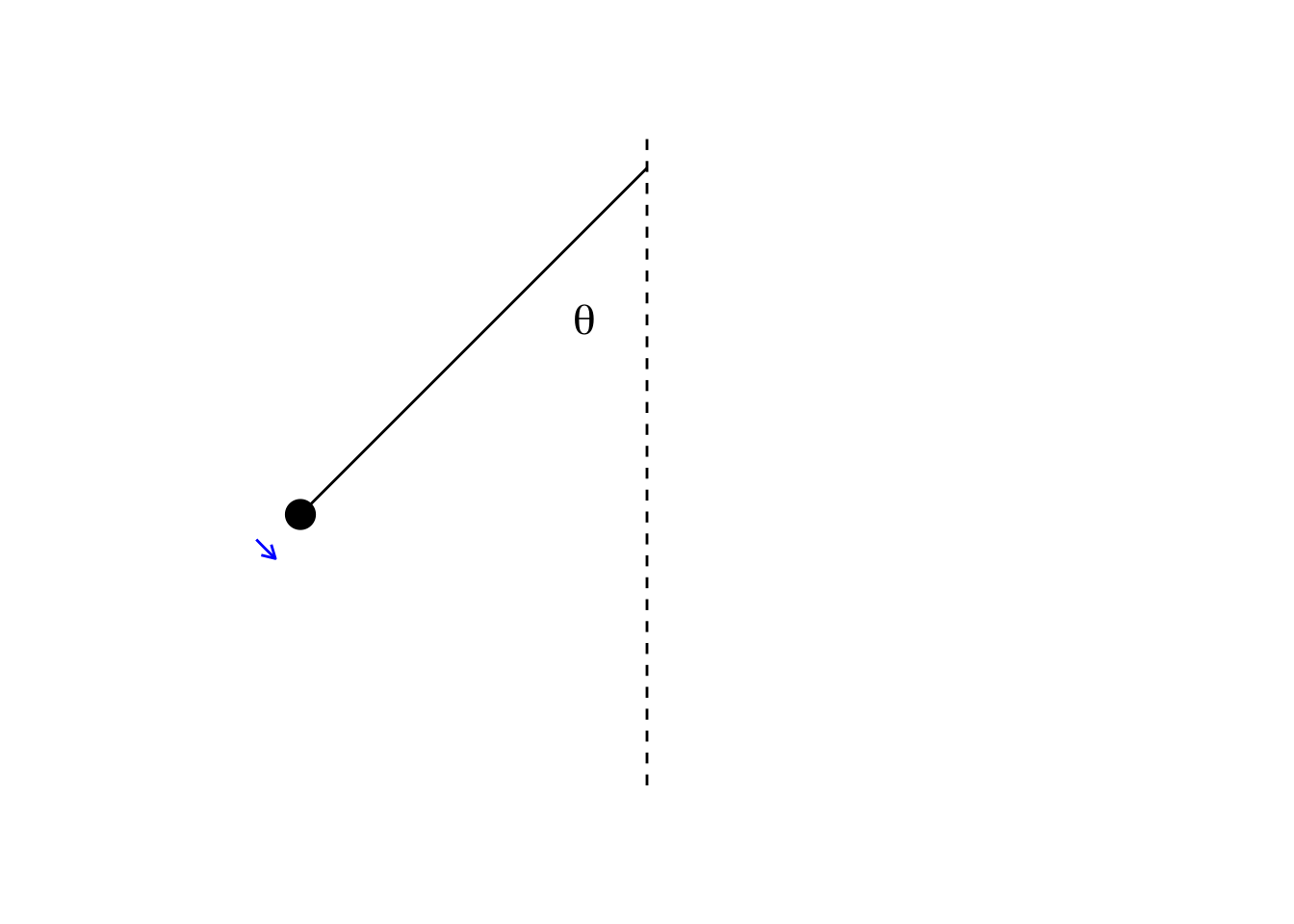
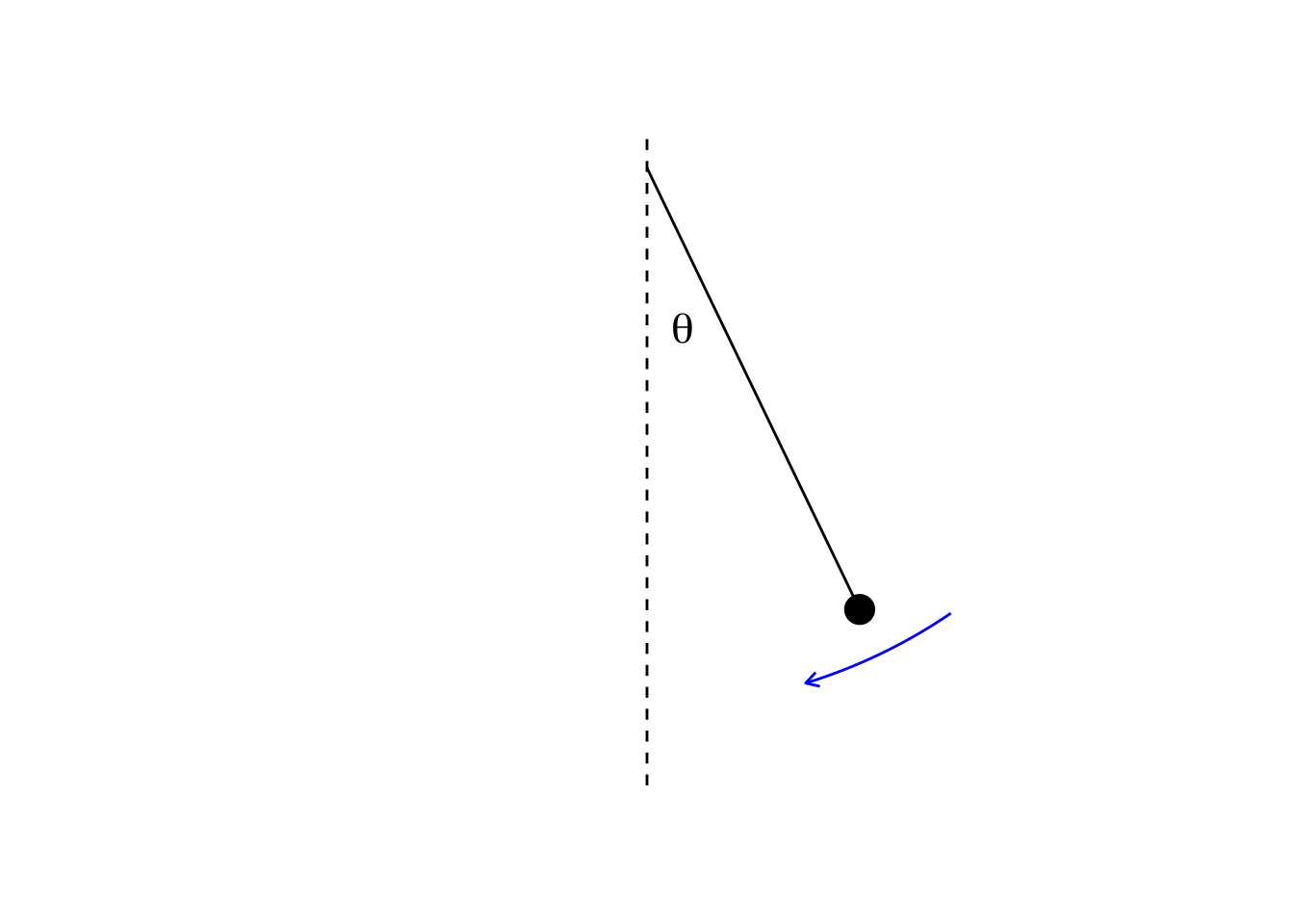
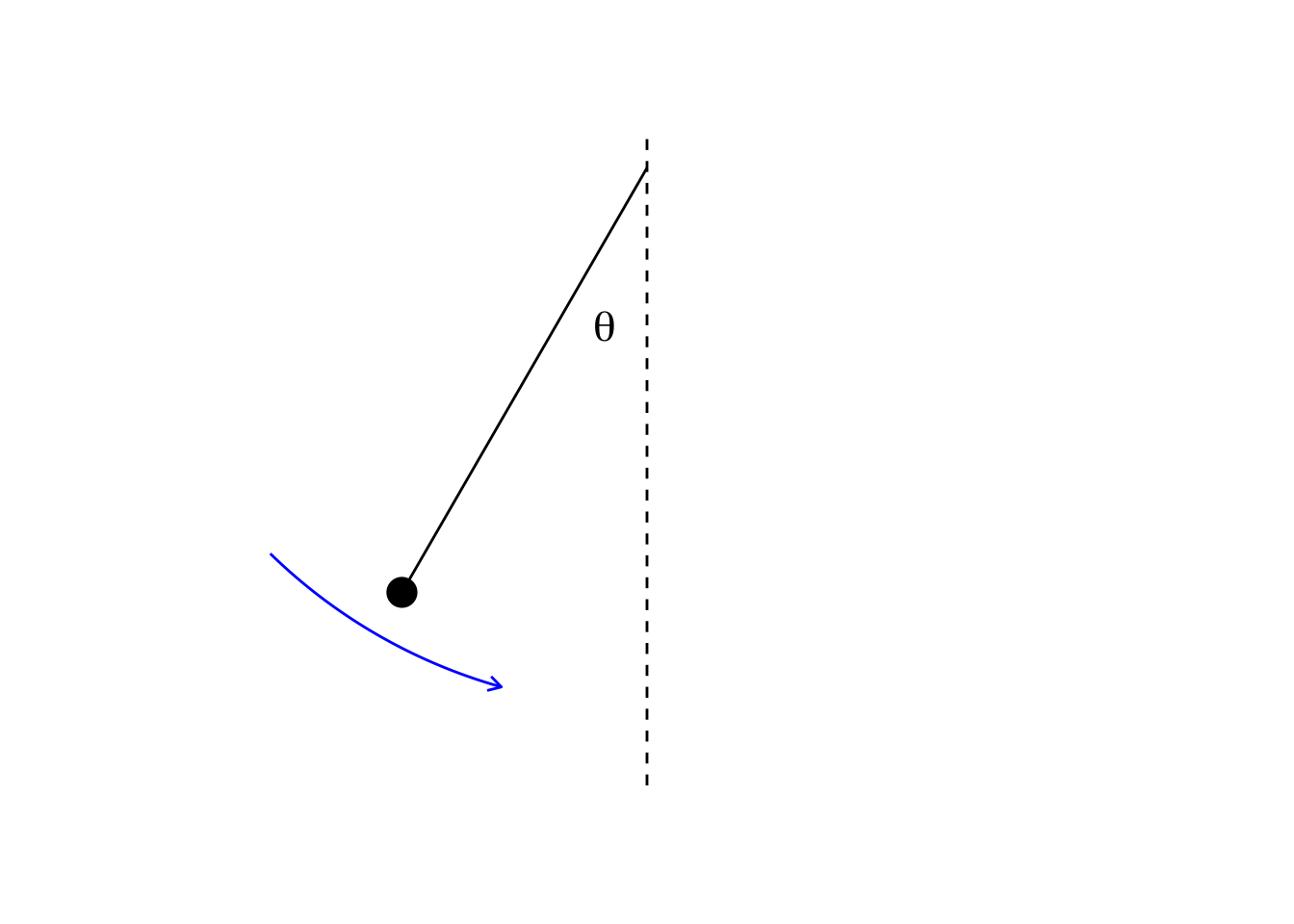
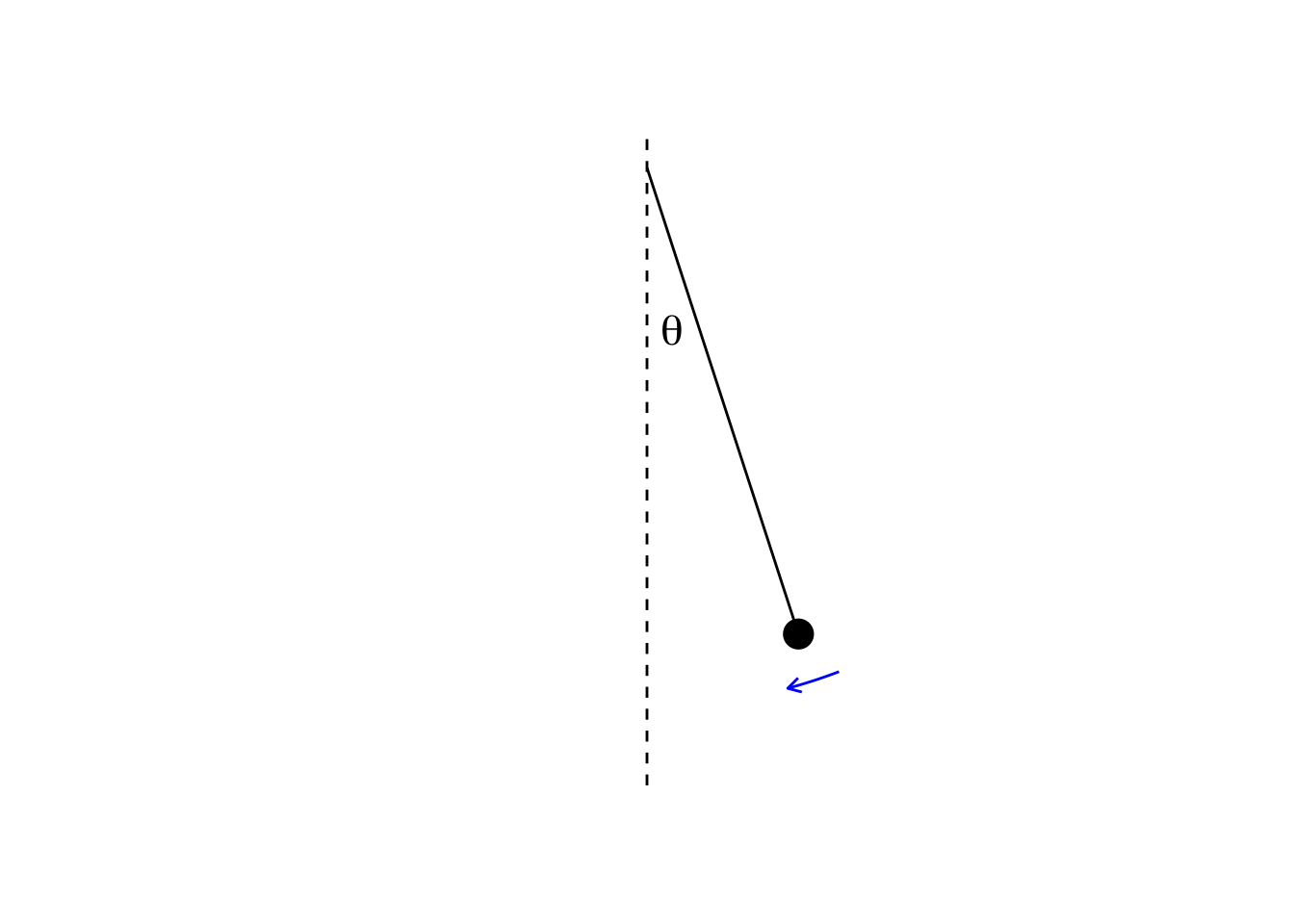
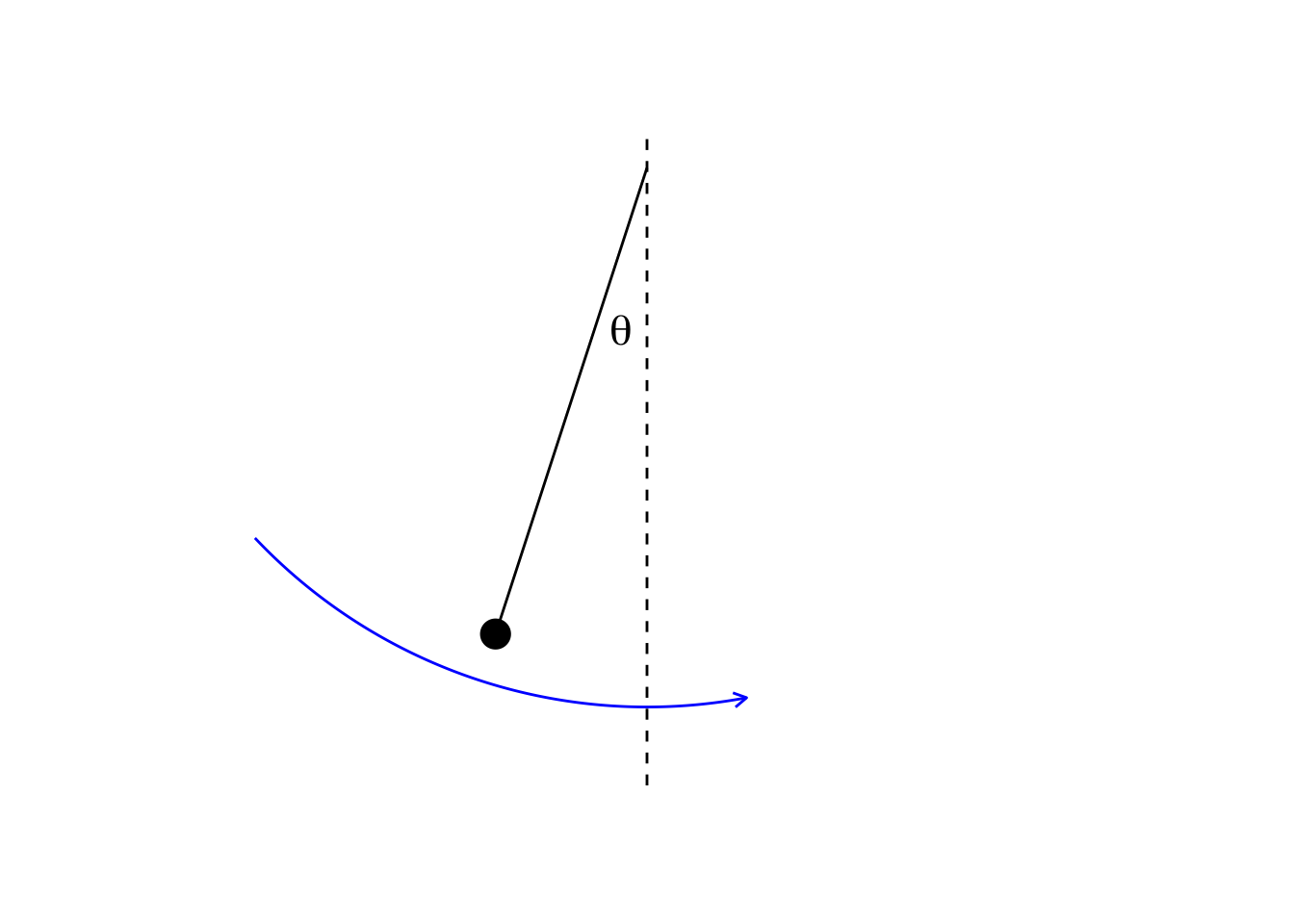
- Which frame shows the pendulum where it is near to the topmost point on its swing.
- For drawing purposes, Figure 2 gives you an empty image of the state space for the pendulum.
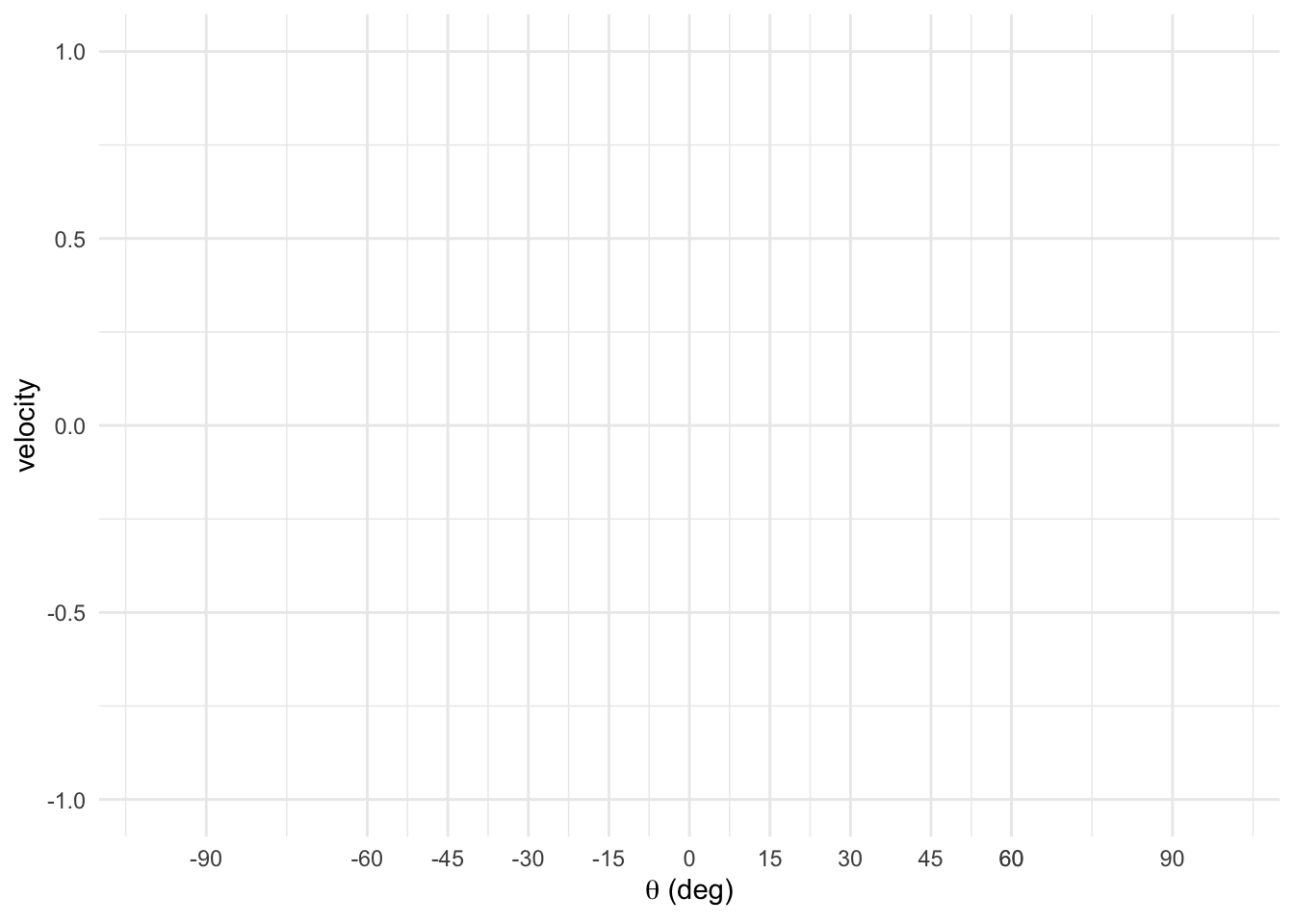
Your task: For each of the six pendulum pictures in UNRESOLVED fig-pendulums-6, write the corresponding letter a-f in the right position in the state space. Imagine that the fastest velocity in UNRESOLVED fig-pendulums-6 is 1. Your answers can be approximate, but they should be correct order relative to one another.
- Return to UNRESOLVED fig-pendulums6-state-space, adding in a vector showing the rate of change of state for each picture with respect to time. Hint: You can tell the rate of change of \(\theta\) by referring to the arrows in UNRESOLVED fig-pendulums-6. But for the rate of change with respect to \(\theta\), you’ll have to draw on your intuition about how a pendulum works. Your answers will necessarily be approximate, but make sure to get the sign right for each quantity.
Exercise 2 Here is the weather forecast for a winter week in Seattle, Washington. The blue numbers, as you may well know, are the probabilities of rain for that day.

- What are the odds of rain on Sunday?
- What are the odds of rain on Monday?
- What are the odds of rain for the first day of the forecast, labelled “Today.”
Exercise 3 Suppose we have an event with possible outcomes A, B, C, D, E. We’ll call the relative probabilities of each of these outcomes rA, rB, rC, and so on. Remember, A, B, C, … are outcomes (e.g. snow, sun, cloudy, …) while rA, rB, rC, and so on are relative probabilities, that is, non-negative numbers. We’ll use pA, pB, pC, … to indicate absolute probabilities.
Assume that rA \(\neq\) pA, that is, that the relative probabilities are not absolute probabilities.
- What is the quantity rA/(rA + rB + rC + rD + rE)?
- What is the quantity rA/(rB + rC + rD + rE)?
- What is the quantity pA/(rB + rC + rD + rE)?
- What is the quantity pA/(pA + pB + pC + pD + pE)?
- What is the quantity rA/(1-rA)?
Exercise 4 In 1990, Philipine President Corazon Aquino appointed retired Brig. Gen. Alfredo Lim to investigate claims that the government lottery was rigged. In September of that year, Gen. Lim won the lottery’s top prize of $200,000. Coincidence?
- What are appropriate competing hypotheses for evaluating the question of coincidence?
- Suppose the lottery was indeed corrupt. Which of the following likelihoods would reflect skepticism that anyone in the lottery management would try to pay off the General?
Tip
Assigning a low likelihood means that it would have been a surprise that the General won even if the lottery were corrupt.
- Suppose that the lottery was honest and that one-million people play it each week. What is the likelihood that the General would win the top prize?
Tip
Some people might think that, because the General won, his probability of winning was 100%. But the likelihood of each possible outcome (e.g. win versus not win) has to be evaluated under the relevant hypothesis. Then, given the actual observed outcome, the likelihood assigned to that particular outcome is the one used.
- What is the likelihood ratio of the rigged versus honest hypotheses given the indicated answers to the above questions about likelihood?
Tip
In constructing a likelihood ratio, you need to decide which hypothesis is in the numerator (top) of the ratio and which in the denominator (bottom). We didn’t use these words in the question prompt, but “H1 versus H2” is a standard way of saying that H1 is in the numerator. The calculated likelihood ratio will then measure the strength of evidence in favor of the hypothesis in the numerator.
- On the verbal scale for interpretting likelihood, what’s the best description for the indicated answer to (4)?
Exercise 5 These questions all relate to a setting where an event can have only two outcomes, outcome A and B.
Suppose the relative probabilities are 3 for A and 7 for B.
- What are the odds of A?
- What are the odds of B?
NoteChap 11Key vocabulary
Only one of the following is a valid description of likelihood. Mark that one.
Only one of the following is a valid description of likelihood framework. Mark that one.
Only one of the following is a valid description of null hypothesis. Mark that one.
Only one of the following is a valid description of scientific method. Mark that one.