graph LR
  X(X)
  Y(Y)
  Z(Z)
  U(U)
  V(V)
  W(W)

  X --> W
  Z --> W
  W --> U
  Y --> U
  U --> V
  Y --> V


classDef exogenous fill:#fff,stroke-width:1px


class X exogenous
class Y exogenous
class Z exogenous
Quantitative Argumentation
Chapter 5 Exercises
Note5.A
Exercise 1 With the metric system, students are taught that the prefixes milli, micro, nano, pico, and so on represent successive powers of ten smaller than the base unit.
For traditional units, even in household where they are used every day, many people don’t know that the unit names also correspond successive powers, but not powers of ten.
Starting with the traditional volume measure “cup”, say how much bigger each of these units is with respect to the previous one.
Exercise 2
- Which quantities are exogenous?
For the endogenous quantities, each of the round-cornered, shaded boxes is a function. The output of the function is the quantity named in the box. The inputs to the function are the names of the quantities that are connected to the box by incoming arrows.
- What are the inputs to the function V()?
- What are the inputs to the function W()?
- Is this collection of functions consistent with the system diagram?
- U(W, Y)
- V(U, Y)
- W(X, Z)
- Consider a new system consisting of these functions and their inputs.
- B(A, E)
- D(B, F)
- F(B)
- C(F, A)
Which are the exogenous quantities?
Exercise 3 Home chefs are advised that there is a safe temperature for cooking poultry: a thermometer inserted into the deepest part of the flesh should reach 165 deg F. This often leads to dry meat. In contrast, “rotisserie chicken,” the sort of fresh, pre-cooked chicken sold by grocery stores, is almost always moist and tasty. How does the rotisserie method achieve this?
There is actually a wide range of temperatures at which chicken can be cooked safely. The key is to hold the meat at that temperature for long enough. At 165 deg F, safety is achieved instantly.
Figure 1 shows the required holding time at a range of temperatures:
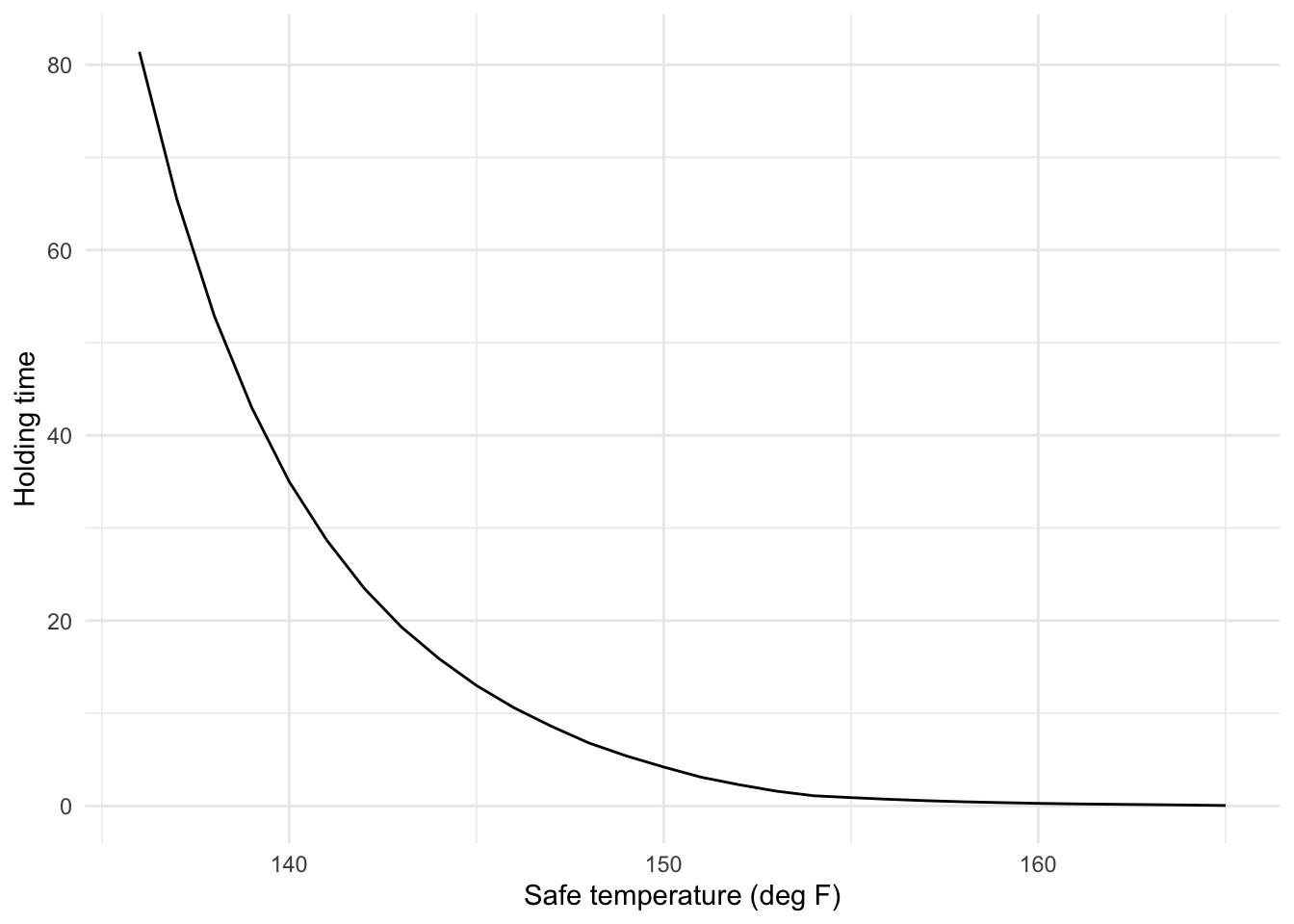
- Suppose you determine to cook your chicken at 140 deg F. Assuming it takes two hours of cooking to ensure that the entire chicken reaches that temperature, how much longer do you need to cook the chicken in order to make it safe?
Naturally, you want to avoid any risk of food poisoning. This could happen, for instance, if your oven runs cool. For instance, an oven set to 140 deg F might actually have cold spots at, say, 135 deg F.
There are two ways to guard against this. One is simply to hold the chicken at the cooking temperature for longer than the answer in Question (1).
- If you want to guard against the possibility of an oven temperature of 135 deg F, how long do you need to hold the chicken at cooking temperature for safety? (Remember, this is the time beyond the original two hours needed to get the bird up to the cooking temperature.)
Home chefs are used to a cooking method where the temperature is set very high (e.g. 350 deg F) and the time carefully regulated to avoid overcooking. Better results can be had at much lower temperatures so long as you take care to hold the bird at the temperature for long enough and check and calibrate your oven to ensure that it is at the right temperature. Commercial rotisseries have ovens set up for this purpose.
Exercise 4
- Which kind of scale is this?

- Which kind of scale is this?

- Which kind of scale is this?

- Which kind of scale is this?

- Which kind of scale is this?
- Which kind of scale is this?

- Which kind of scale is this?
Exercise 5 Consider the range of weights of these mammalian species: bat, cat, human, cow, whale. (You may have to do a web search to get typical values.) How many orders of magnitude are spanned between a bat and a whale?
Exercise 6 Consider the data on the body mass (kg) and brain mass (gm) for 62 species of mammals shown in Figure 2. (You can hover the cursor over a point to see the species name.)
- The lesser short-tailed shrew has both the smallest body mass and brain mass. What is the brain mass of the short-tailed shrew? (Pick the answer that’s closest.)
- The water opossum, arctic fox, nine-banded armadillo, and rock hyrax (in the middle of the cloud of points) all have about the same body mass. What is that body mass? (Pick the answer that’s closest.)
- Which of these animals has a body mass closest to 10 kg?
- Of the mammals in the range of body masses from 10 to 100 kg, which has the smallest brain size?
- The gray bar surrounding the blue line in Figure 2 contains about 2/3 of the 62 mammals plotted. Which animal has the smallest ratio of brain mass compared its range of body masses?
Figure 3 shows the daily sleeping time versus lifetime for the 62 mammals. The level of danger from predation that the animal is exposed to is shown by color.
- The mammal who sleeps the least sleeps how many hours per day?
- A chinchilla lives about 7 years. What level of danger does the chinchilla face?
- The Sleep axis is linear, while the Lifespan axis is magnitude. Explain why this choice makes sense (or if it doesn’t).
Exercise 7 Usually you read the order of magnitude from the integer following the e. For instance, the order of magnitude of 1.56e13 is simply thirteen. But for the devious purposes of this drill problem, we’ve written some of the numbers in non-standard form.
The standard form for writing a number in scientific notation has, as you know, two components: a mantissa and an exponent. The mantissa is written to have one non-zero digit to the left of the decimal point. The exponent must always be an integer, that is \(\ldots, -2, -1, 0, 1, 2, 3, \ldots\).
- Which one of the following is not in standard form?
- Which one of the following is not in standard form?
Suppose you have a number written in non-standard form, e.g. 36.525e1. To change this to standard form, you need to divide the mantissa by 10, that is, move the decimal point one place to the left. To compensate for the division by 10, you need to raise the exponent by 1. This gives 3.6525e2
Similarly, when the leading digit of the mantissa is zero, for instance 0.0052e1 conversion to standard form requires moving the decimal point to the right until the leading digit is non-zero. To compensate for moving the decimal point, you need to subtract the number of places moved from the exponent. So to put 0.0052e1 in standard form we need to move the decimal point three places to the right and, in compensation, subtract 3 from the exponent. This gives 5.2e-2.
- For each of these mantissas, how do you have to move the decimal point to place the mantissa in a standard form for scientific notation? (3L means “three places to the left” while 2R means two places to the right.)
3a. 92425.01
3b. 0.00314e3
3c. 1.00026e-3
- Three of the following numbers have the same order of magnitude. Which one doesn’t?
Exercise 8 In everyday speech, a “decade” corresponds to 10 years, “two decades” to 20 years, and so on. In magnitude graphics, a decade refers to something different. On a magnitude scale, as on all numerical scales, there is a lowest marked value and a higher marked value. If the higher marked value is 10-times the size of the lowest, that scale covers one decade. If the higher marked value is 100-times the size of the lowest—that is, two orders of magnitude bigger—the scale is said to cover two decades. A span of three orders of magnitude corresponds to three decades, and so on.
- How many decades are spanned by this interval: [0.01 to 10]?
- How many decades are spanned by the interval [10 to 1000]?
- How many decades are spanned by the interval [0.3 to 30]?
Sometimes an interval doesn’t cover a full order of magnitude. For instance, the in scale [10 to 30], the higher value is not even 10 times the lower. But, when the higher number is 3 times the lower, we way that the interval covers “half a decade.” Why “half?” Two half orders of magnitude places the higher value at \(3 \times 3 \approx 10\) times the lower value. Since since a factor of 10 is one decade, a factor of 3 is (roughly) half a decade.
- How many decades are spaned by the interval [10-300]?
- How many decades are covered by this scale?

- How many decades are covered by this scale?

Exercise 9 Official standards for bacterial cleanliness are set on a scale measuring what proportion of bacteria may survive a cleaning. For instance, the Mr. Clean bottle claims to eliminate 99.9% of bacteria, that is, that only one in a thousand bacteria will survive.

Experts often us a more “scientific”-sounding logarithmic scale. For instance, food safety might be set at a “7 log\(_{10}\) lethality.” This means that of 107 bacteria, only one might survive.
On the “log\(_10\) lethality” scale, how clean is Mr. Clean?
Exercise 10 There are many situations in which we adopt units so that commonly encountered measurements have just two or three digits. Both the Fahrenheit and Celsius temperature scales have the nice feature that commonly encountered outdoor temperatures have two digits. Those familiar with the Fahrenheit scale know that temperatures on weather maps tend to range from -30 to 120°F. For Celsius, the range -20°C to 40°C does the job. Students in the US learn that atmospheric pressure is about 14.7 pounds per square inch.
Tire pressures for cars and bicycles are frequently denominated in one of three units: pounds-per-square inch (psi), bar, and pascal (P). If you are unfamiliar with tire pressure, you might have to do a tiny bit of web research to answer these questions.
- Which of the three units gives pressures that can be expressed with two or three digits?
- Which of the three units uses 3 digits, and even then has to be modified by an order-of-magnitude prefix?
- Which of the three units requires a decimal point to denominate car tire pressures to a suitable precision of \(\pm\) 10%?
(The unit “pounds per square inch” is often abbreviated “psi,” but this obscures that we are dividing by square inches, not multiplying). Inflate a car tire to about 35 psi, a bicycle tire to about 60-100 psi. The metric unit of pressure is a pascal (P), but it is poorly suited to representing everyday pressures: bike tires are in the range 400 to 700 kPa. Instead of pascal, people in the metric world tend to use a different unit: bar. Inflate a car tire to 2.5 bar, a bicycle tire to 4-8 bar.
Exercise 11 The New York Times Magazine (Nov. 30, 2025) reported on a surge in e-bike injuries. The article sensibly pointed to the rapid increase in e-bikes sales as a factor in the surge.
As the pandemic continued, the number of e-bike accidents increased. “You would expect that,” Alfrey says, “because sales were skyrocketing.” Indeed, in 2022, over a million e-bikes were sold in the United States, up from 287,000 in 2019, according to the Light Electric Vehicle Association.
The article pointed out that the increase in e-bike sales has not been as sharp as the increase in injuries.
During the same [three]-year period when nationwide sales quadrupled, e-bike injuries increased by a factor of 10, to 23,493 from 2,215, according to the National Electronic Injury Surveillance System. A study by the University of California, San Francisco, found that from 2017 to 2022, head injuries from e-bike accidents increased 49-fold.
- What do you think the units are for the reported e-bike sales?
- What do you think the units are for the reported injuries?
- What’s your opinion? Is it appropriate to compare the rapidly growing e-bike yearly sales to yearly injuries.
- What is the approximate doubling time for e-bike sales, according to the information presented in the article?
Explain the reasoning that led to your conclusion about the doubling time.
- Accident rates are typically proportional to exposure; the more an activity is undertaken, the larger the number of accidents per year associated with that activity. Which of these would you expect to be proportional to the number of accidents per year?
Bicycle sales per year is a rate of change: the change in the number of bicycles divided by the change in time. We are given information about bicycle sales, but we need information about the total number of bikes on the road. Making this conversion in the form of information—from a rate of change of a quantity as opposed to to the quantity itself—can be accomplished by accumulating the rate of change over time.
To perform the accumulation, we need to look at the sales in each year of the period. We know the number of sales in 2019 and 2022: about 250,000 and one-million respectively.
- Using the numbers in the previous paragraph, how many doubling occurred from 2019 to 2022? How many years elapsed from 2019 to 2022?
The doubling time is the span of years divided by the number of doublings. If D is the doubling time in years, then the proportional increase from year to year is exp2(1 / D).
We’ve done the calculation for you about bicycles sales in each year using the proportional increase from year to year. Your job is to use the accumulation method to calculate the number of bikes on the road in each year.
| Year | 2013 | 2014 | 2015 | 2016 | 2017 | 2018 | 2019 | 2020 | 2021 | 2022 |
|---|---|---|---|---|---|---|---|---|---|---|
| Sales | 15K | 25K | 40K | 60K | 100K | 160K | 250K | 400K | 630K | 1000K |
| On road | 15K | 40K | 80K | … | … | … | … | … | … | … |
- Assuming that the number of bikes on the road in any year consists of the bikes sold through that year, how many bikes were on the road in 2017?
- Using the same assumption as in (7), how many bikes were on the road by 2019?
- Using the same assumption as in (7), how many bikes were on the road by 2022?
The article says that e-bike injuries increase 10-fold over the period from 2019 to 2022, while bike sales only increased 4-fold. Coincidentally, the number of bikes on the road increased by slightly more than 4-fold from 2019 to 2022, so the 10-fold increase in injuries does reflect a growing injury rate per bicycle.
The number of head injuries, in contrast, increased 49-fold from 2017 to 2022. But there was a 7-fold increase in the number of bicycles on the road. So the head injury rate per bicycle increased “only” 7 fold.
The article mistakenly says “four-year period.”
NoteChap 5 Key vocabulary
Only one of the following is a valid description of logarithm. Mark that one.
Only one of the following is a valid description of magnitude. Mark that one.
Only one of the following is a valid description of order of magnitude. Mark that one.
Only one of the following is a valid description of scientific notation. Mark that one.
Only one of the following is a valid description of sorting. Mark that one.