Quantitative Argumentation
Chapter 12 Drill Questions
NoteA. Odds and probabilities
Exercise 1 There are two outcomes possible: Win or Lose. Your personal opinion is that the relative probabilities of Win and Lose are 15 and 25, respectively.
- What’s the odds of Win?
- What’s the odds of Lose?
Exercise 2 There are only two horses in the race: Valentine and Epitaph. Valentine’s odds are 9 to 6.
- What are Epitaph’s odds?
- Which of these is a correct statement of the relative probabilities for Valentine and Epitaph respectively?
Exercise 3 It may seem strange that mathematics has two different but equivalent ways of quantifying how likely a given outcome is from a random event: absolute probability and odds.
To understand the equivalence, consider the possible outcome A from a random event. Suppose this has absolute probability of \(p\) and odds of \(d\). These two formulas show how to calculate one from the other.
\[\text{absolute probability}\ \ p = \frac{d}{1+d}\ \ \ \ \ \text{and}\ \ \ \ \ \text{odds}\ \ d = \frac{p}{1-p}\]
- If the odds of A is 2, what is the absolute probability of A?
- If the absolute probability of A is 50%, what is the odds of A?
- Which of these ranges expresses the highest and lowest possible values for an absolute probability?
- Which of these ranges expresses the highest and lowest possible values for an odds? (Hint: plug in the ends of the correct range from (3) into the formula for odds.)
Exercise 4 For some strange, textbook reason you are in a closed room with no windows. You have been there so long that you don’t know what day of the year it is. You wonder what the temperature is like outside.
Here are four shapes of relative probability functions that take temperature as input.
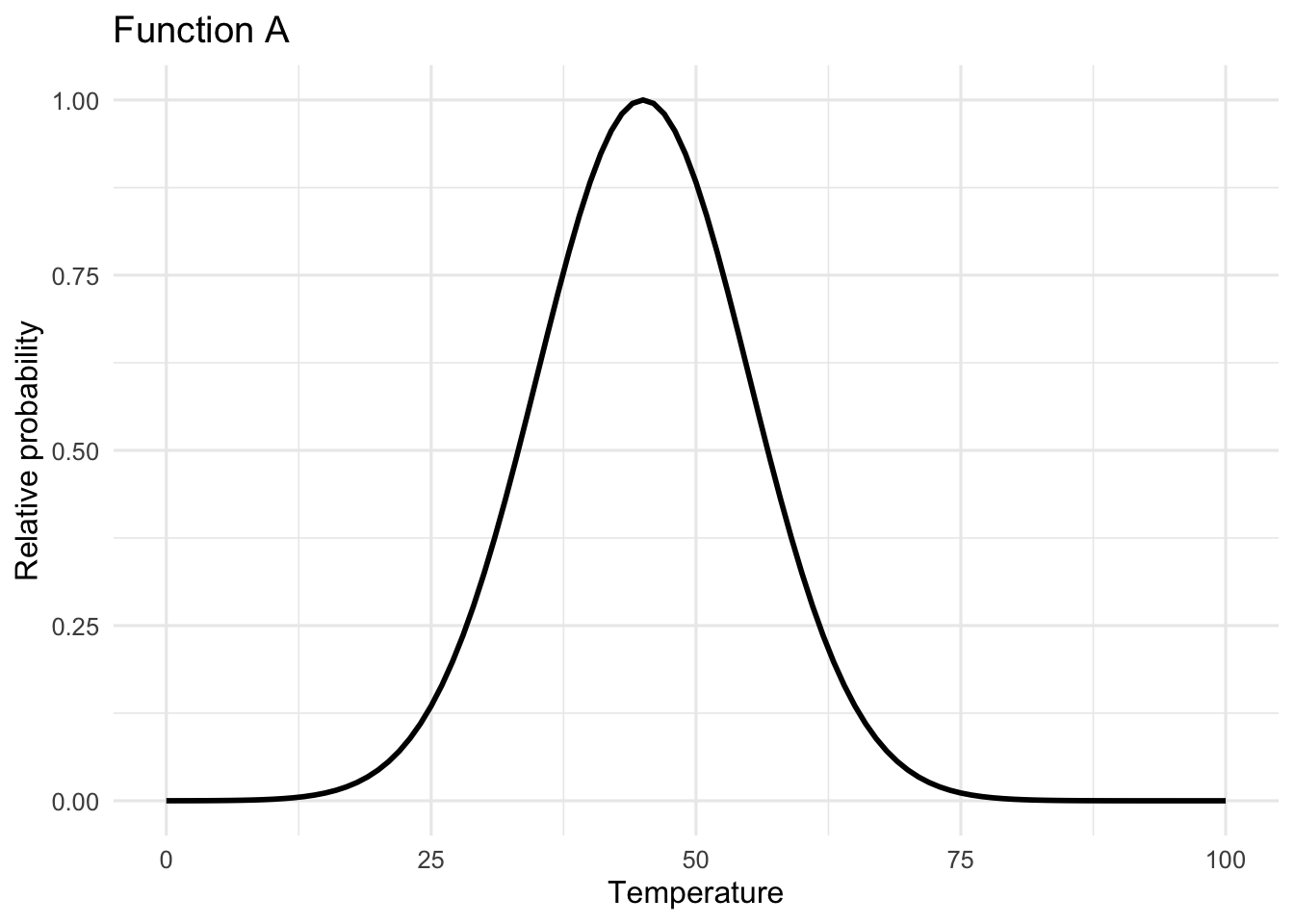
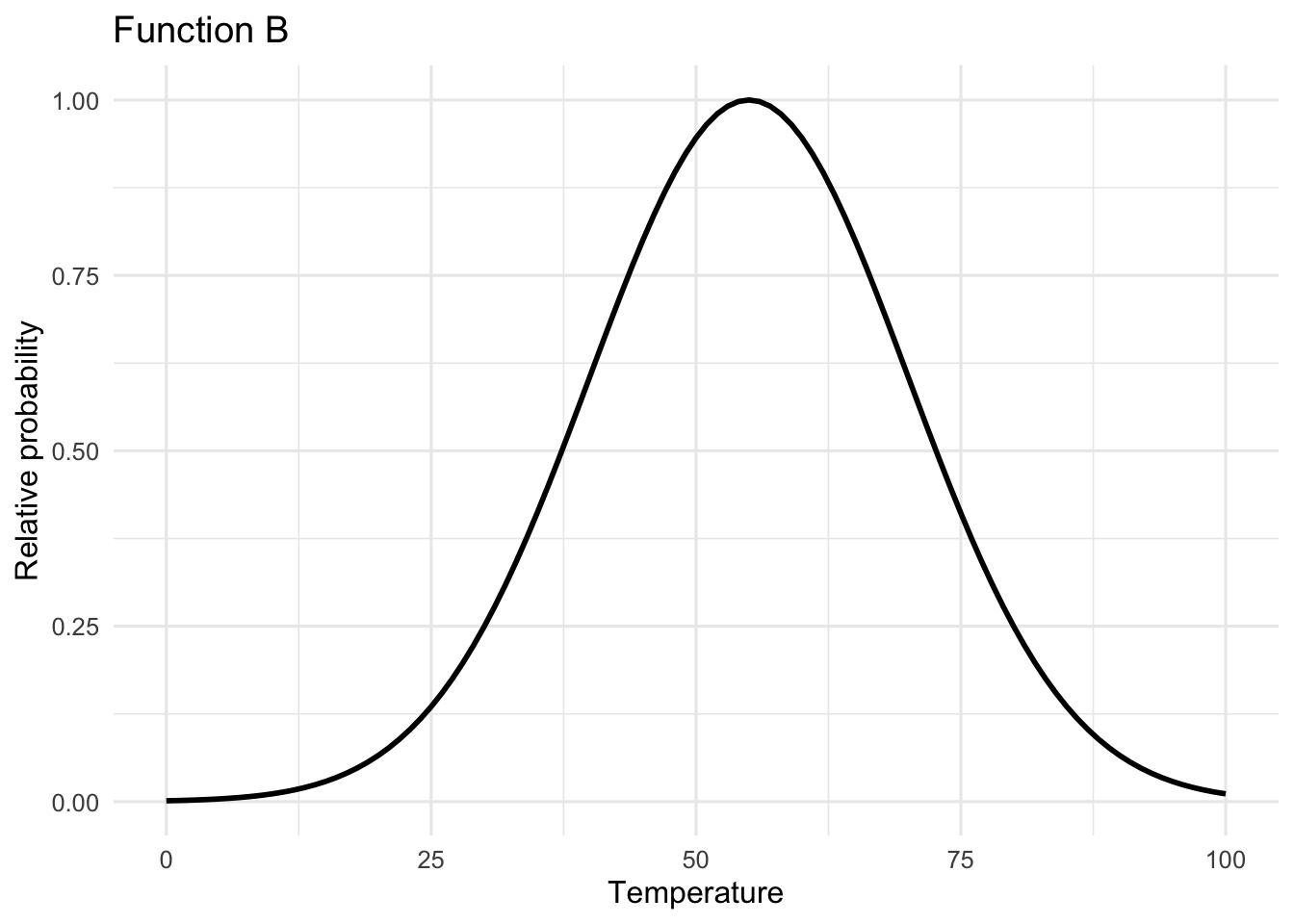
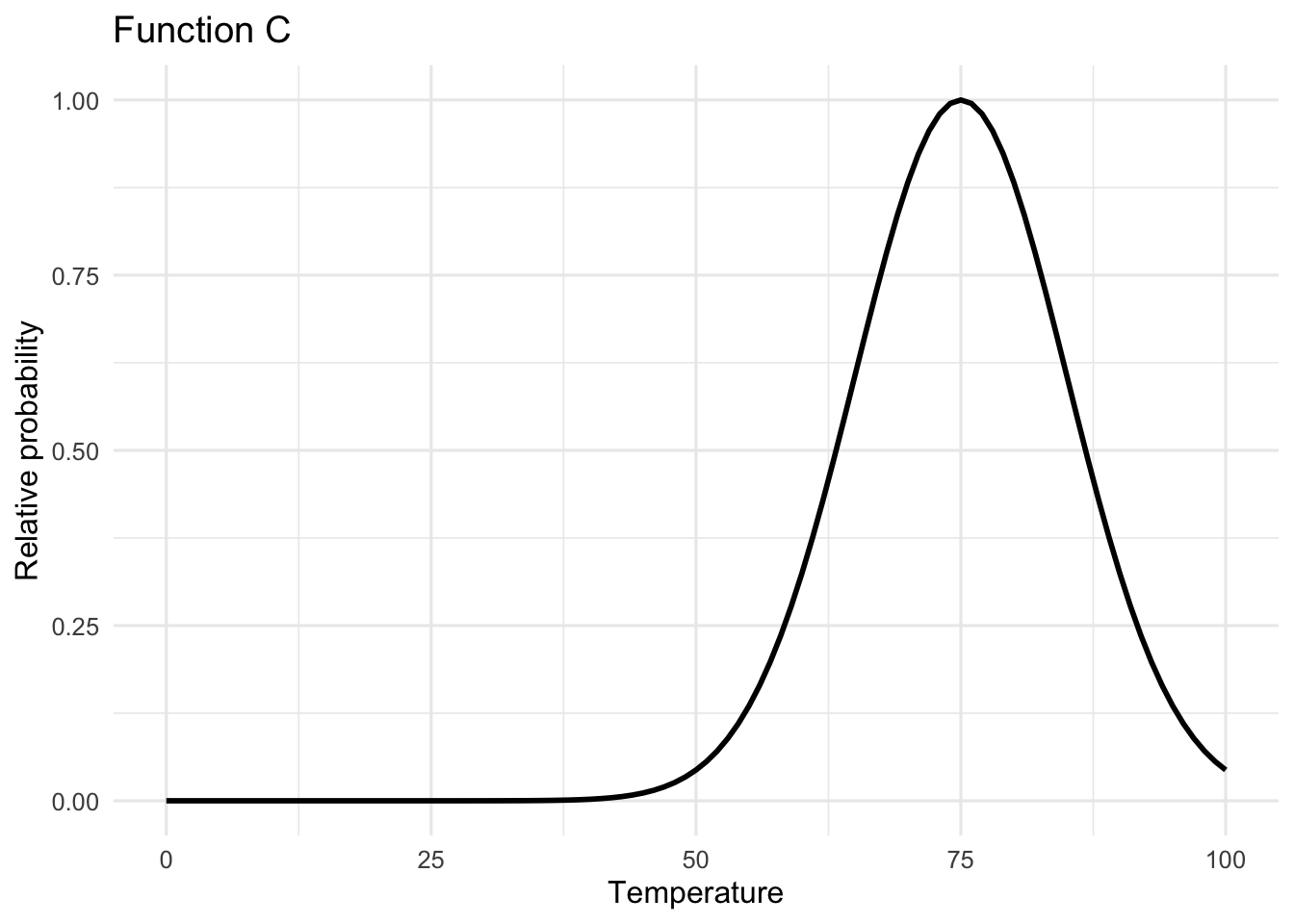
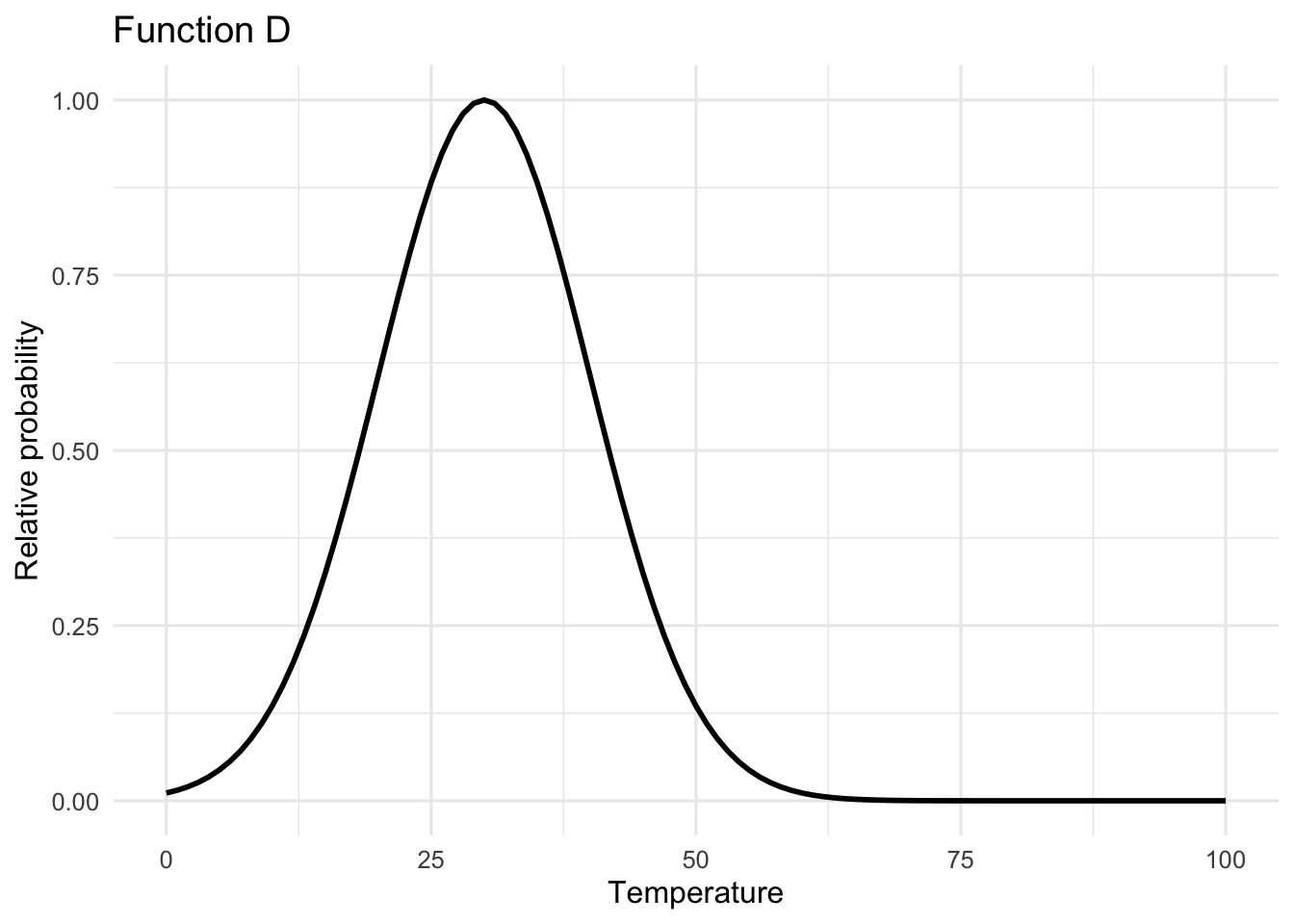
- Which of the four functions best represents a sensible prior belief about the temperature?
Eager to know more about the time of year, you ask to have a thermometer read-out installed which shows the outside temperature.
- Which of the four plots shows a sensible likelihood for temperature under the hypothesis that it is either spring or fall?
- What is the best of the following criterion for judging which of the four functions is suitable for the prior?
- Which of the four plots shows a sensible likelihood for temperature under the hypothesis that it is summer?
NoteKey vocabulary
Two of the following are valid descriptions of posterior. The other three are not. Mark both of the VALID descriptions.
devoirs3::devoirs_selection(
  label = "posterior-12-two",
  question = "Two of the following are valid descriptions of posterior. The other three are not. Mark both of the VALID descriptions.",
  answers = posterior_12_two_choices,
  multiple = TRUE
)()
Two of the following are valid descriptions of prior. The other three are not. Mark both of the VALID descriptions.
devoirs3::devoirs_selection(
  label = "prior-12-two",
  question = "Two of the following are valid descriptions of prior. The other three are not. Mark both of the VALID descriptions.",
  answers = prior_12_two_choices,
  multiple = TRUE
)()